Tuesday, May 24, 2011

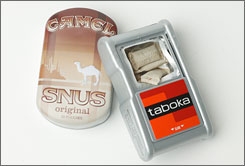
Snus focus of yearlong study

A University of South Carolina researcher is preparing to answer two questions with widespread implications for the tobacco industry and public-health community.
Can a smokeless product, in this instance Camel Snus, contribute to a smoker quitting cigarettes — particularly one who doesn’t want to stop?
If it does, could an increase in use of smokeless-tobacco products over cigarettes cause a net harm to the population?
Trying to provide clarity is Matthew Carpenter, an associate professor in the Department of Psychiatry and Behavioral Sciences and the Department of Medicine at the Medical University of South Carolina. Carpenter’s research focus has been on tobacco use and control, with his studies primarily funded by the National Institutes of Health.
The yearlong study will consist of 1,250 smokers nationwide, half being given Camel Snus or another smokeless product, and the other half given nothing.
Carpenter’s research team wants to learn whether Snus leads to quit attempts, smoking reduction and cessation. They also want to measure the amount and pattern of Snus use.
“The study will provide strong, clear and objective evidence to guide clinical and regulatory decision-making for this controversial area of tobacco control,” Carpenter said.
Matt Myers, president of the Campaign for Tobacco-Free Kids, said research of smokeless products must evaluate what harm is caused by the product along with how the product is marketed.
“If a smokeless product reduces the risk of disease, but results in more people using tobacco, it could result in more deaths, not fewer,” Myers said.
Carpenter said researchers are not trying to encourage the use of smokeless tobacco with the study.
“We’re just trying to mimic the real-world scenario of a smoker being exposed to these products in their own environment, such as a grocery store,” Carpenter said.
“If they decide to use them, what is the effect? We believe no matter the determination of this study, it will have a public-health impact.”
The study follows up on a similar smoking-cessation study Carpenter released in February 2010 on Star Scientific Inc.’s Ariva and Stonewell tobacco lozenges.
The main determination of that study was smoking decreased by 40 percent during the two-week study period, but overall use of tobacco remained stable.
“This suggests that Ariva and Stonewall are effective products to curb withdrawal and craving,” Carpenter said in his report. “We found no changes in overall craving or withdrawal, as smokers substituted Ariva/Stonewall for cigarettes.
“We found no evidence that smokeless tobacco (Ariva or Stonewall) undermines quitting. To the contrary, readiness to quit — in the next month and within the next six months — significantly increased among smokers who used a smokeless-tobacco product relative to those who continued to smoke conventional cigarettes.”
Carpenter said it is “doubtful that a smokeless-tobacco product could ever serve as a total substitute for cigarettes among a majority of smokers.”
“However, the amount of substitution among those smokers who choose to use smokeless products is not insignificant,” he said.
* * * * *
The multimillion-dollar Camel Snus study is part of an initiative the National Cancer Institute began in October 2009.
The institute wants to determine whether smokeless products, such as snus and dissolvable Camel Orbs, Camel Sticks and Camel Strips from R.J. Reynolds Tobacco Co., provide “a truly less-harmful alternative to conventional tobacco products, both at the individual and population level.”
“We want to explore all aspects of tobacco products, including the sale, marketing and health risks,” said Michele Bloch, medical officer of the Tobacco Control Research Branch of the National Cancer Institute.
Carpenter said “a number of short-term lab studies of toxicant exposure suggest smokeless tobacco could offer reduced harm as compared to conventional cigarettes.”
Major U.S. tobacco manufacturers, led by Reynolds, are putting more emphasis on smokeless products to gain market share and sales as the smoking rate among adults is declining. Government figures show that fewer than 44 million Americans smoke, down from a peak of 53.5 million in 1983.
“We certainly support studies conducted objectively while using sound scientific principles and techniques on the use of tobacco products and tobacco-harm reduction,” said David Howard, a spokesman for Reynolds.
The evolution of some health-advocacy groups from anti-smoking to anti-tobacco is ratcheting up the moralistic aspect of buying and consuming a legal product.
Some advocates say that smokeless tobacco can serve as a gateway for youths to smoking.
Others are encouraging the Food and Drug Administration to allow the advertising of smokeless tobacco as less harmful than cigarettes if such claims can be proved through research.
A study of smokers ages 18 to 70 — released in November by the Tobacco Use Research Center of the University of Minnesota — found that “quit rates for Camel Snus were comparable to those obtained with nicotine-replacement therapy.”
The Minnesota center said a “properly powered study is needed to determine if use of smokeless-tobacco products with higher nicotine content can be an effective path to smoking cessation, perhaps especially among smokers who are not interested in or previously were not successful with using approved pharmacotherapies.”
Reynolds added fuel to the debate in December when it launched its first campaign aimed specifically at encouraging smokers to switch to Camel Snus.
* * * * *
Reynolds has marketed Camel Snus as an option for tobacco consumers who can’t smoke in a growing majority of public venues.
Carpenter acknowledges the intensity of debate in his abstract. “There is limited evidence to determine if potentially reduced exposure products ultimately undermine or promote public health,” he said.
John Spangler, a professor of family and community medicine at Wake Forest University School of Medicine, said he supports research that determines whether smokeless tobacco can help with quitting cigarettes.
Spangler is conducting a National Cancer Institute study, which began in September 2009, that’s aimed at developing strategies to encourage reduced use or even quitting smokeless-tobacco products. Wake Forest received a $2.9 million grant for its study.
Among the goals are: determining the health risk of smokeless-tobacco products; whether the products serve as a gateway for nontobacco users, particularly teenagers and young adults, into smoking; and whether they can be accurately marketed as a reduced-risk alternative to cigarettes.
“We have a substantial amount of data in our research showing that users of smokeless tobacco have a very high likelihood, not of quitting smoking, but of co-using smokeless and cigarettes,” Spangler said.
Bill Godshall, executive director of SmokeFree Pennsylvania, said, “I’d be shocked if Reynolds would apply to market it as a smoking-cessation drug device.”
Scott Ballin, past chairman of the Coalition on Smoking or Health, said the study could demonstrate that there is not enough evidence available about reduced risk, “therefore products like snus or Ariva or Stonewall should not be able to make any claims.”
“That would preserve the status quo and give the pharmaceutical companies the competitive protections they want,” Ballin said.
In October, the consumer health care division of GlaxoSmithKline (GSK), which sells nicotine-replacement therapy products Nicorette and NicoDerm, requested that the FDA take Reynolds’ dissolvable tobacco products out of test markets.
The FDA acknowledges Reynolds is marketing the products to adult consumers, but has concerns that the marketing and shape of the dissolvable products might appeal to children and adolescents.
GSK’s request strikes at the core of Reynolds’ attempt to create a reputation as an innovator of products that could be less harmful to consumers than cigarettes.
Elizabeth Whelan, president of the American Council on Science and Health, said “GSK is clearly trying to protect its own market for dissolvable tobacco.”
“From a business perspective, this is understandable,” Whelan said. “But from a purely public-health point of view, if products like the orbs can help more smokers quit more effectively than other cessation products, then let them stay on the market.”
Thursday, May 19, 2011

Imperial Tobacco aims for organic growth

Please respect FT.com’s ts&cs and copyright policy which allow you to: share links; copy content for personal use; & redistribute limited extracts. Email ftsales.support@ft.com to buy additional rights or use this link to reference the article – http://www.ft.com/cms/s/0/12f6fb72-817a-11e0-9c83-00144feabdc0.html#ixzz1MmICfwRO

On the first anniversary last week of Alison Cooper’s appointment as chief executive of Imperial Tobacco, an analyst at Investec Securities reminded investors of the fundamental question that she needs to answer: can the FTSE 100 tobacco company transform itself from the M&A machine it has been over the past two decades into a vehicle for organic growth?

The tobacco marketShareholders may have been temporarily distracted from that question by the announcement that Imperial would begin buying back shares.

The company has paid down debt from its last big deal – the acquisition of Altadis, maker of Gauloises Blondes, in 2008 – to just over two times earnings.

It will also push up dividends, hitting 50 per cent of adjusted earnings this year and aims to increase them ahead of the rate of earnings growth.

But with investors’ “cash return bloodlust now sated” – as the Investec analyst Martin Deboo put it – the organic growth question is nagging again.

Please respect FT.com’s ts&cs and copyright policy which allow you to: share links; copy content for personal use; & redistribute limited extracts. Email ftsales.support@ft.com to buy additional rights or use this link to reference the article – http://www.ft.com/cms/s/0/12f6fb72-817a-11e0-9c83-00144feabdc0.html#ixzz1MmIFjvWz

Ms Cooper does not deny the importance of the answer, for employees as much as investors. She recalls how, a year ago, some staff had seemed hesitant about the new direction she was advocating.

She wants to turn a team skilled at bedding down new businesses – from Australian, Dutch and African acquisitions in the late 1990s, to Reemtsma of Germany in 2002 and Altadis six years later – into one that can increase market share and volumes through better sales and marketing.

“They all said, ‘we like Alison, we really want to go for it’,” she says. “But they wanted to get some meat on the bones.” Enthusiasm has grown in the course of the year, she believes, as seen at a recent management meeting in Prague. “All the feedback from Prague was, ‘we really see it’.”

She has also brought in fresh blood. Two recent hires – a marketing director from Reckitt Benckiser and a sales director from Metro Group, the German retail business – underscore her belief that Imperial should think of itself as a regular fast-moving consumer goods company and that organic growth, not M&A, is top of the agenda.

Investors, meanwhile, saw some signs of progress in the company’s half-year results. Sales of its premium Davidoff brand were up 9 per cent, helped by a strong performance in emerging markets. And while the West value brand had subdued growth – up just 1 per cent – and cigarette volumes were down as a whole, fine-cut tobacco volumes rose 5 per cent.

“In most of my discussions with the investment community, I feel there’s a general growing confidence with the organic growth story,” says Ms Cooper.

Mr Deboo is less convinced. He points out that market share declined in the six months to March 31 in 11 of the company’s 20 reported markets, including Russia, France and regulation-hit Spain.

To counter these trends, Ms Cooper has been creating “cocktails” of solutions, designed for each territory. They are based on the notion that Imperial can improve revenues not just through pricing and cigarette sales, but by selling cigars, fine-cut tobacco, rolling papers and filters, even rolling machines.

The difficult UK market, where Imperial generates 13 per cent of its revenues via brands such as Lambert & Butler, Regal and Golden Virginia, is a good example. The company is coping with poorer, recession and austerity-hit smokers by pushing fine-cut tobacco as a cheaper alternative to cigarettes. This year, it introduced an alternative to roll-your-own tobacco: cigarette-making kits, with filters already fitted into tubes, and a special cut of loose tobacco to be fed into the tubes using a machine.

Julian Hardwick of RBS says: “There’s a perception in the market that the European Union is not a good place to have a tobacco business. One of the strong views that Alison has is that there are always growth opportunities. It may not be in cigarettes, it may not be in premium cigarettes, but there are always going to be opportunities, and it’s very important that Imperial capitalises on them through its ‘total tobacco’ portfolio. That’s a key mindset that’s brought to the whole business.”

If Ms Cooper can’t capitalise on these opportunities, M&A could be back on the agenda – this time with Imperial as the target.

Some of the 12 per cent climb in the share price since the start of the year has come on the back of research by analysts at Goldman Sachs arguing that four global tobacco companies – Philip Morris, British American Tobacco, Japan Tobacco and Imperial – is still one too many. They argue that debt across the sector is low, volumes are stagnating and competition issues are not insurmountable, particularly if BAT were to buy Imperial.

Ms Cooper, who occasionally deviates from the on-message, unironic language of top managers to show a more jaundiced view of the world, is sceptical: “Anything to do with four to three has got very significant antitrust issues; I always describe it as not impossible but very difficult. But I’m sure bankers in particular will continue to speculate. Because I’m sure they’d love the fees on a deal like that.”

Her counterpart at BAT, meanwhile, who is also new to the job, says M&A will not be his focus for the next few years at least.

Mr Hardwick, of RBS, argues, like Ms Cooper, that if the market were taking bid speculation seriously, the shares would be much higher than they are. Even Mr Deboo says that the stock is a safe buy, “the closest thing to a bond available in the equity market”. He contests the notion, however, that Imperial is cheap next to rivals with greater emerging markets exposure.

Ms Cooper prefers to see emerging markets as one of the opportunities on offer for a company occupying fourth position in the global market. For the M&A bulls on the sidelines, being fourth could offer other tantalising opportunities, too.

The Financial Times Limited 2011. You may share using our article tools. Please don’t cut articles from FT.com and redistribute by email or post to the web.

Thursday, May 12, 2011

Philip Morris International: Alternative Annual Report

Philip Morris International: Alternative Annual Report
Every year, one of the world’s best-known corporations provides its shareholders a glowing image of a company that is handsomely rewarding its shareholders by expanding into new markets, developing new products, and overcoming market and regulatory challenges.
The truth is that this corporation makes its billions of dollars in profits at the expense of people’s health and their lives. This report reveals the dark truth behind how Philip Morris International earns its profits.

Philip Morris International (PMI) is the world’s largest, deadliest and most profitable publicly traded transnational tobacco corporation. PMI currently operates in 180 countries and holds more than 27 percent of the international tobacco products market (excluding the People’s Republic of China and the United States). In 2010, PMI reported revenues (excluding taxes) of over US $27 billion and an operating income of US $11.2 billion. Another way to look at it: That’s $5,500 in profits for every person who has died so far this year from tobacco-related disease.

FINANCIAL LOWLIGHTS: THE PRICE PAID FOR PROFITS

PMI reported 11.6 percent growth in profits and an increase of 4.1 percent in its cigarette shipment volume in 2010. This increase in profits and volume contributes to:

One tobacco-related death every six seconds worldwide. That’s 5.4 million people every year.
Premature deaths. On average, smokers lose 15 years of life and up to half of all smokers will die of tobacco-related causes.
Higher healthcare costs and lost productivity. Tobacco causes a $500 billion global economic drain each year — nearly $74 for each person in the world.
For every dollar of PMI revenue, health care expenses and productivity loss cost the world economy $7.39.

To achieve these profits, PMI:

Spends nearly $5 on its so-called corporate social responsibility initiatives for every tobacco related death — a means of distracting attention from its core business of selling a harmful and deadly product.
Implements a range of tactics to undermine the success of public health policies that protect people from the harms of tobacco, including:

Friday, April 15, 2011

Marlboro cigarettes are registered brand cigarettes of Altria.

Marlboro cigarettes logo
They are one of the most popular and preferable brands not only all over the world. Marlboro cigs were introduced in 1924 as a "women cigarettes" but during the World War II they disappeared because the sales dramatically decreased. It was decided to start new promotional campaign and advertise them to the male smokers. Marlboro reappeared and quickly became popular due to the wise advertising campaigns that used Marlboro man cowboy figure, which later became an American icon to capture attention of male smokers. The red cigarette pack was advertised for almost fifty years by all possible means of advertisement: on billboards, in store window displays, on the pages of magazines and newspapers.
Buy now your Marlboro Cigarettes brand from one of the largest retailers of cigarettes worldwide. Most of the top brands discount cigarettes including Marlboro Cigarettes are available in cigarea.com store and ready to be delivered fast and fresh to your doorstep.
You can choose your favorite brand Marlboro Red Box cigarettes, Marlboro Lights Box cigarettes, Marlboro Medium Box cigarettes, Marlboro Ultra Lights Menthol Box cigarettes and Marlboro Lights Menthol Box cigarettes at discount prices from our online cigarettes shop and enjoy smoking cheap but high-quality tobacco products. Make your choice of our exquisitely flavored Marlboro cigarettes.

Tuesday, April 12, 2011

Philip Morris vs Norway in front of the EFTA Court

Philip Morris vs Norway in front of the EFTA Court
This is one of the first legal challenges brought against the most recent tobacco control policy: display ban of cigarettes. Its outcome is expected to indirectly determine also the legality of the first display ban adopted within the EU (in EIRE) and to shape the ongoing reform of the EU tobacco products directive.

In an attempt to cut impulse buys of tobacco products and to further reduce smoking rates, five countries (Australia, Canada, Iceland, Ireland and Norway) have recently banned the display of tobacco products at the point of sale.
As with many tobacco control policies, both the scientific basis and the legality of display bans are questioned today. This is certainly the case for plain packaging, as we have recently reported here and here.

As the first empirical evidence about the public health effectiveness of display bans begins to emerge (the Icelandic measures dates back 2001), Philip Morris recently took the Norwegian state to court in an attempt to overturn the law banning the display of cigarettes in stores. In Norway, since January 2010, cigarettes have been banished to closed cases, while cigarette dispensers may no longer display brand labels. This is how the closed cases look:

cigarettes display
“Display bans have had no impact on reducing smoking in the countries that have implemented them, a fact acknowledged by the Norwegian Ministry of Health and Care Services. Instead these regulations prevent adult consumers from seeing the available product range and overly restrict competition” said Anne Edwards, spokesperson for PMN. “We have raised these issues with the government to no avail, which has regrettably left us with no choice but to litigate.”
The goal of the lawsuit is to overturn the display ban to permit retailers to display tobacco products in their stores enabling adult smokers to see the products on offer.
The Oslo district court decided to request, last October, for an advisory opinion to the EFTA Court regarding the compatibility of the contested display ban with the EEA Agreement (i.e. a Treaty extending considerable portions of EU legislation to non-EU countries, such as Norway). This Court, having jurisdiction with regard to EFTA States which are parties to the EEA Agreement (at present Iceland, Liechtenstein and Norway), is competent inter alia to give advisory opinions to courts in EFTA States on the interpretation of EEA rules.
In essence, in case E-16/10, Philip Morris Norway AS and Staten/Helse- og omsorgsdepartementet, the Norwegian national court asks the EFTA Court whether the display ban constitutes an obstacle to the free movement of goods within the meaning of Article 11 of the EEA, which – as is typically the case in the EEA Agreement – is identical to Article 34 of the Treaty on the Functioning of the EU, prohibiting measures having an equivalent effect to a quantitative restrictions.
Being the EFTA Court bound by the « principle of homogeneous interpretation », its case law is based on the ECJ’s case law as far as such jurisprudence exists. The case law of the ECJ on Article 34 and the free movement of goods is vast. Yet the measure at stake in Philip Morris Norway is of a type which has not yet come before the European Court of Justice.
This would seem to allow the EFTA Court, as it already occurred in the past, to set a precedent. Although the ECJ is not bound by the principle of homogeneous interpretation and may depart from the EFTA’s interpretation of identical provisions contained in EU law, it referred – in a number of cases – to EFTA Court case law as a main or even a leading argument when interpreting EU law. This is relevant to the extent one EU country, Ireland, has implemented since July 2009 a display ban.
Although the compatibility of display bans with EU/EEA law is a novel issue, this does not mean that the EFTA Court won’t find any guidance in the case law of the ECJ. As is well known, the ECJ after having given a broad interpretation of the prohibition of measures having an equivalent effect to a quantitative restriction (by including also non distinctly applicable measures), it held in Keck that ‘certain selling arrangements’, i.e. measures concerning the circumstances of selling the goods, are covered by this provision, only if they discriminate against imports in law or in fact.
Will the EFTA Court apply the Keck jurisprudence to the Norwegian display ban? This may have a considerable impact on both the reasoning and the outcome of the case.
Should the Court qualify a display ban as a ‘selling arrangement’, this measure might escape from the scope of application of the prohibition and being upheld without being subject to a scrutiny of its underlying public health rationale. Yet to do so the EFTA Court should conclude that:

1. a display ban is a ‘selling arrangement’;
2. the application to tobacco products from other Member States of the display ban is not such as to hinder directly or indirectly, actually or potentially, trade between Member States :

a. “so long as those provisions apply to all relevant traders operating within the national territory; and

b. so long as they affect in the same manner, in law and in fact, the marketing of domestic products and of those from other Member States”.
Previous case law shows that while requirement a) of the Keck test is easy to verify, requirement b) is trickier, especially when dealing with a measure limiting (rectius, banning) the possibility of advertising a product. Here it might be crucial to look at the percentage of local cigarettes sold in Norway vs those imported. A display ban of tobacco product might indeed ossify the market by crystallising existing patterns of consumption and raising barriers for new entrants. Yet this has never been a concern in the (non) EU market for cigarettes!
Interestingly enough, in a number of cases, the EFTA Court has indicated that it does not take the ECJ’s Keck jurisprudence for the last word of the wisdom. (See e.g. Cases E-5/96 Nille, 1997 EFTA Court Report, 30, at para 28 et seq., with reference to ECJ 17 October 1995 – C-124/94 – DIP and Others v Comune di Bassano del Grappa and Comune di Chioggia, 1995 ECR, I-3257; E-4/04 Pedicel EFTA Court Report [2005] 1). At the same time though, attempts by EFTA States to have provisions of the EEA Agreement interpreted differently from those of the EC Treaty because of an alleged difference in scope have been rejected.
Should the display ban be considered a restriction – what seems quite likely and that regardless of the application of the Keck jurisprudence, the discussion – as predicted by the second question raised by the referring court – will shift to its possible justification.
To what extent the Norwegian display ban, based on the declared objective of reduced tobacco use by the public in general and especially amongst young people, is it proportionate, i.e. suitable and necessary, having regard to public health?
In examining the first prong of the proportionality test, the EFTA Court is likely to face an abundant amount of conflicting data advanced by the parties concerning the effectiveness of the display ban in reducing consumption and prevalence in smoking. In our view, to determine the suitability of the measure to achieve the desired objective the Court will have to establish at least the potential effectiveness of display bans in changing smoking behaviour (by looking, for instance, at pre- and post-display ban adolescence prevalence in Norway). Is there a causal link between banning display and reduction in tobacco consumption? Moreover, when examining necessity, the second prong of the test, the EFTA Court will have to determine whether the desired objective (public health) could be attained by less onerous methods. In a country like Norway, where most forms of advertising of tobacco products are already prohibited – now also at the point of sale -, this won’t be an easy exercise to carry out. In any event, according to established case law, – because of the margin allowed to the legislature – to fail the proportionality test, a measure has to be “manifestly inappropriate” having regard to the objective pursued before judicial intervention. This reading of the proportionality test reflects concerns of legitimacy and expertise. Yet never forget that – as observed by Advocate general Jacobs extra judicially – “proportionality is a flexible tool of judicial review, which is applied differently in different context”.
The deadline for receiving written observations from Governments and relevant institutions having expired (according to the EFTA Court website – besides the Norwegian government and the EFTA Surveillance authority – only the European Commission would seem to have lodged its observations), the hearing of the case is expected in June 2010 in Luxembourg.
Although other legal challenges have been initiated by the tobacco majors against the spreading of tobacco display bans, this is the first international legal challenge brought against one of the most recent tobacco control policies. Its outcome is expected to indirectly determine also the legality of the first display ban adopted within the EU and, more importantly, to shape the ongoing reform of the EU tobacco products directive. Indeed, under section 6 of the DG SANCO public consultation document, anticipating the reform, the EU Commission discusses – among several regulatory options aimed at controlling the access to tobacco products – the possibility of introducing EU-wide mandatory display restrictions or bans at points of sales. In the meantime, both the UK and Finland have announced to intend to follow Ireland in prohibiting the display of tobacco in large shops from October 2011 and in points of sale as from the beginnings of 2012, respectively.
A more detailed analysis of the pending EFTA case (E-16/2010) is forthcoming in issue 2 of the European Journal of Risk Regulation, which is expected by next June.

Monday, April 4, 2011

Two tobacco products free of FDA oversight

Two tobacco products free of FDA oversight
How dissolvable tobacco products are made could determine whether or not they fall under the jurisdiction of the Food and Drug Administration.

Star Scientific Inc., a maker of dissolvable tobacco lozenges, announced Wednesday that it received an FDA notice saying that two of its products are not subject to regulations in the federal Food Drug & Cosmetic Act.

The determination could open the door for other dissolvable tobacco products, such as R.J. Reynolds Tobacco Co.’s Camel orbs, sticks and filmlike strips for the tongue, to also not be subject to FDA regulation.

The industry, led by Reynolds, has put more focus on smokeless tobacco as a revenue source in recent years as the number of U.S. adults who smoke has dropped to about 20 percent.

According to the federal act, smokeless tobacco is defined as “any tobacco product that consists of cut, ground, powdered or leaf tobacco, and that is intended to be placed in the oral or nasal cavity.”

The Star products are Ariva-BDL and Stonewall-BDL — the acronym stands for “below detectable levels” of certain cancer-causing chemicals in tobacco, particularly when it is burned as part of smoking. Star has sold a different version of Ariva and Stonewell for years.

Star declined to discuss its proprietary manufacturing process. Some analysts said its process may involve tobacco being compacted or compressed, rather than made into powder — evidentially enough of a distinction to not qualify as smokeless tobacco.

“It’s a head scratcher how the FDA made its determination since we applied for the products to be considered as a modified-risk tobacco product,” said Sara Machir, a spokeswoman for Star.

Star said that the notice came from a statement by Dr. Lawrence Deyton, the director of the FDA’s Center for Tobacco Products. Deyton said he based the decision on the information submitted by Star.

The FDA verified Deyton’s statement that “not all tobacco products are currently subject” to the act. At this time, only cigarettes, cigarette tobacco, smokeless tobacco and roll-your-own tobacco are subject.

Jeffery Ventura, a spokesman for the FDA, said that the agency “recognizes there are uncertainties regarding the regulatory status of a variety of nicotine-containing products derived from tobacco; more specifically, whether these products are regulated as drugs or tobacco products.

“The FDA is considering its legal and regulatory options regarding these products.”

With the notices in hand, Star said it will proceed with the marketing and selling of the BDL versions of Ariva and Stonewell. Machir said it could take two months for the products to reach retail shelves.

“These initiatives will be undertaken consistent with our belief that adult tobacco users should be able to have information about the toxin levels in all tobacco products,” said Paul Perito, the chairman, president and chief operating officer of Star.

Star continues to pursue FDA approval for a moist-snuff product that it said has the lowest levels of carcinogens — in this case nitrosamines — in the marketplace. That includes “99 percent lower than the levels found in conventional American moist snuffs, such as Copenhagen or Skoal, and 90 percent less than the level found in current snus products,” the company said.

David Howard, a spokesman for Reynolds, said that according to company policy, “communications with the FDA regarding specific products is confidential.”

Bill Godshall, the executive director of SmokeFree Pennsylvania, is an outspoken advocate for smokeless tobacco as a reduced-risk alternative to cigarettes. He said he is curious about how the FDA made its determination.

“Does this mean that some/many/most/all other dissolvable-tobacco products also aren’t smokeless tobacco?” he asked. “It also appears Star can now claim its Ariva BDL and Stonewall BDL are less-hazardous alternatives to cigarettes.

“Maybe Reynolds will also have to apply for modified-risk status for their dissolvables to find out.”

Scott Ballin, the past chairman of the Coalition on Smoking or Health, said that the FDA’s decision “is indicative to me that people are beginning to realize that not all tobacco-containing products are the same.”

“I have said for more like two years that the current statute is outdated and we need to be looking at a better, fairer regulatory system that regulates the most toxic products more stringently than the lower risk ones.”